In Space, No One Can Hear You Compute
Since Congresswoman Alexandria Ocasio-Cortez asked her congressional committee if anyone would want to live next to a data center, many have observed that an anti-data center movement is one of the few bipartisan issues in highly polarized America today. AOC has mentioned both water use and noise as two of the most undesirable aspects of data centers. However, it’s useful to realize that these two issues are also at odds with each other: most data center noise comes from air-cooling systems, which generates low-frequency sound energy. Water-cooled systems are often more expensive to build, but by using water instead of air, they can also be built vastly quieter if a large source of water is available. Many data center companies prefer to instead build a cheaper air-based system and simply pay for a poorly-written sound study which gives projected values in dBA but does not actually have any predictive power for noise annoyance in the surrounding area.
Now a lot of the Silicon Valley conversation has shifted to Elon Musk’s assertion that SpaceX will be able to shift data centers into outer space. From a solar power perspective and zoning perspective, this makes a certain amount of sense, as well as some hopeful assertions about the efficiency of radiative cooling in orbit. However, from a noise perspective the advantage would obviously be that all sound stops in the vacuum of space, and we back down on the surface will not have to hear these hundreds of thousands of servers spinning all day.
I don’t claim to be a spaceflight engineer, but Sam Harsimony at Splitting Infinity recently posted reasons for thinking that given the presence of convective as well as radiative cooling on Earth makes cooling more efficient on Earth than in space under most radiator temperatures:
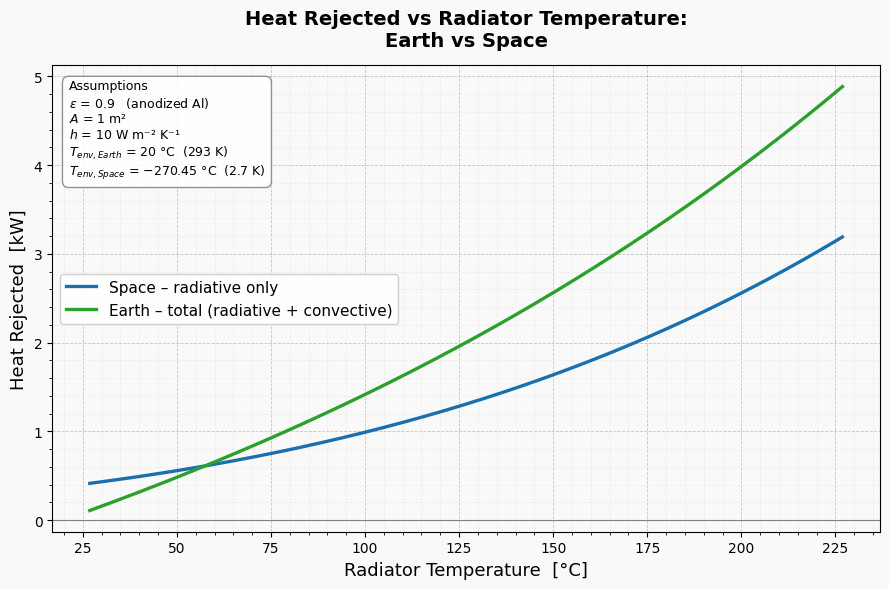
(see here for a more optimistic take on the economics of data centers - you can add your own assumptions and put it into a calculator…). Clearly space would need to have a big built-in price advantage at some level to make the physics of this seem even remotely plausible for VC investors.
Aside from purely economic considerations, IEEE has a great Youtube video showing many other engineering considerations required for space-based data centers that haven’t been fully addressed by the space-stans yet. (Did you know that the ISS requires 3 separate servers running redundantly from each other to protect against bit-flipping from cosmic rays?) As the video concludes, military use might be the main instigator of space-based data centers because a) they don’t need to make a profit, and b) they would be hard for most people to destroy once they’re up there.
However, the military application is not the primary type of data center most people are worried about when they ask me about data center noise (clearly the US Army has been exploding things since before noise codes existed). For commercial data centers, the economics are key, and based on current technology and fuel prices, the economics don’t make space-based data centers look like they’re likely to be a realistic noise abatement strategy in the next 5-10 years.
It’s worth emphasizing, too, that if we could write a reasonable data center noise ordinance which actually dealt with low-frequency noise and adequately priced the externalities these data centers create, that regulation itself could help shift the needle toward making space-based data centers more cost-effective. Clearly the demand for compute is not going away - it is merely a question of where we are going to put it.