How Not to Write a Data Center Noise Ordinance
One of the big problems with data center noise is that it often affects rural areas, where neighbors have an expectation of peace and quiet. Data centers originally became an issue in suburban DC, but since the AI boom they are now expanding into places like Conway, Arkansas:
In 2023, Conway’s leadership adopted a Data Center Noise Ordinance, the most stringent noise regulation applied to any commercial or industrial use in Conway. The noise level allowed at the property cannot be above typical conversation volume.
The facility’s design includes noise mitigation and will be subsequently reviewed for noise concerns. Noise levels will be evaluated on an ongoing basis.
That sounds promising! But on inspection of the ordinance in question, it’s not so promising…
It shall be unlawful for any Data Center to make or continue to cause or permit to be made or continued, noise levels constituting a noise disturbance. For the purposes of this section, the external noise level emanating from Data Centers shall be deemed disturbing to a person, reasonably calculated to disturb the peace and unreasonably offensive and injurious to the public, or their property, if the sound level is … 65 dBa or higher during the hours of 8 A.M. to 10 P.M. or 55 dBa or higher during the hours of 10 P.M. to 8 A.M. (as determined by a third-party acoustic engineer) measured at the property line of the receiving property.
Now, there are some good things there (such as a stricter limit for nighttime conditions, when you’re trying to sleep and there’s less background noise). But when the daytime limit is written in such a way to completely miss data center noise in the first place, the stricter nighttime limit may not be strict enough either.
Below you can see two graphs: the first shows the A-weighted and C-weighted curves used to measured dBA and dBC. The second graph shows the difference between the curves, by frequency (in dB).
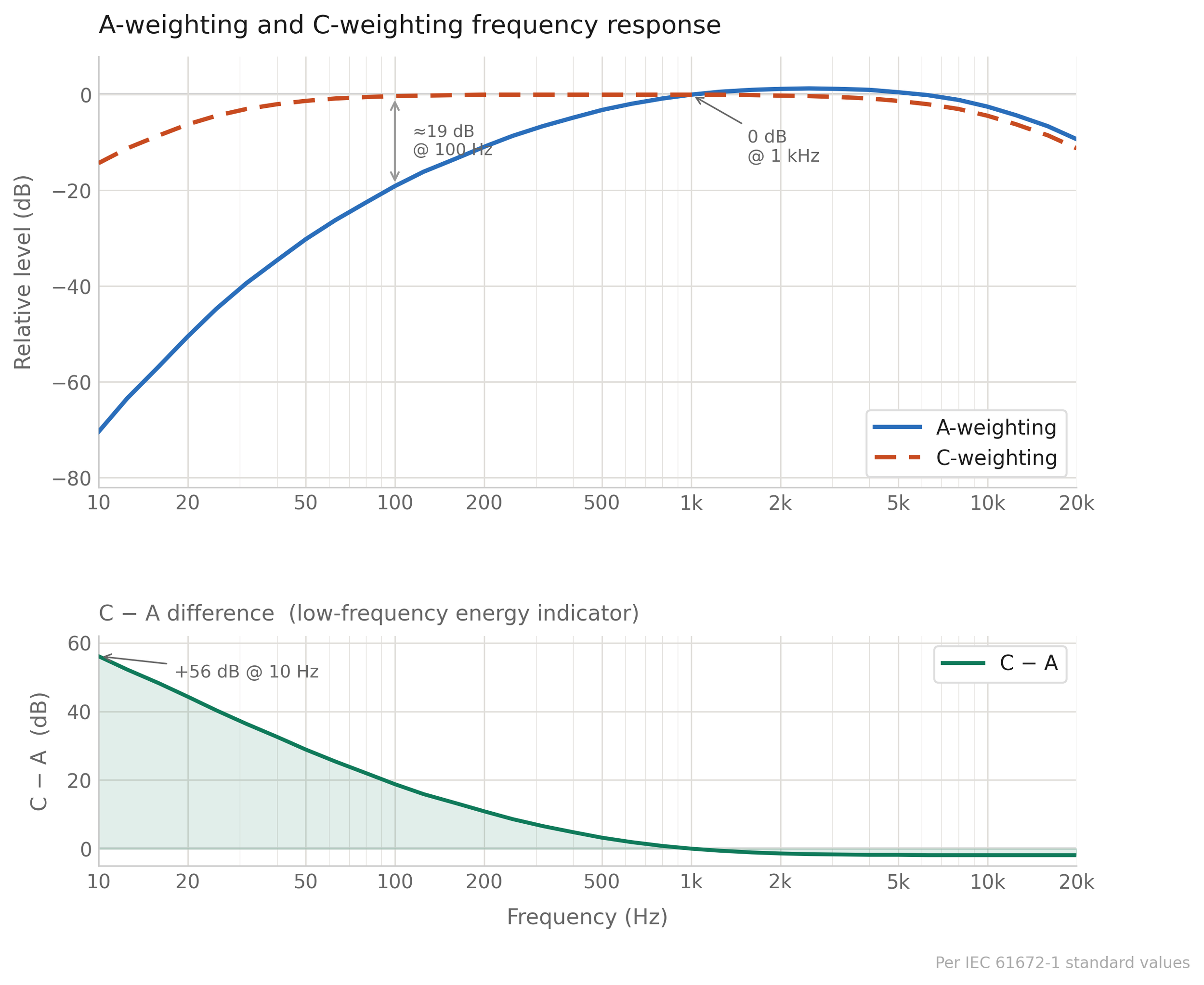
dBA vs. dBC, by frequency (Hz)
The A-weighted curve approximates the frequency response of the human ear at moderate levels (about 60 dB, like a conversation). The C-weighted curve approximates the frequency response of the human ear at higher levels (about 80 dB, like a busy city street). You can see that the ear becomes much more sensitive to low-frequency sound when the overall sound pressure level increases.
Data center noise is often around 100 Hz (sometimes lower, sometimes higher), which corresponds to a 19 dB difference between the C-weighted curve and the A-weighted curve. So when the Conway ordinance allows noise levels up to 65 dBA during the day, that would actually allow overall pressure of about 84 dB if all the energy is concentrated in a low-frequency hum at 100 Hz, as is typical of data centers.
A-weighted values are the most obvious way for data centers to hide the true extent of the their noise! Any noise ordinance which purports to deal with data centers should require C-weighted values at the very least.
We are going to need better data center noise ordinances, but this is not the way to write one.