The Hum in the Woods: What We Know About Data Center Noise and Birds
Data Center Vs. The Birds
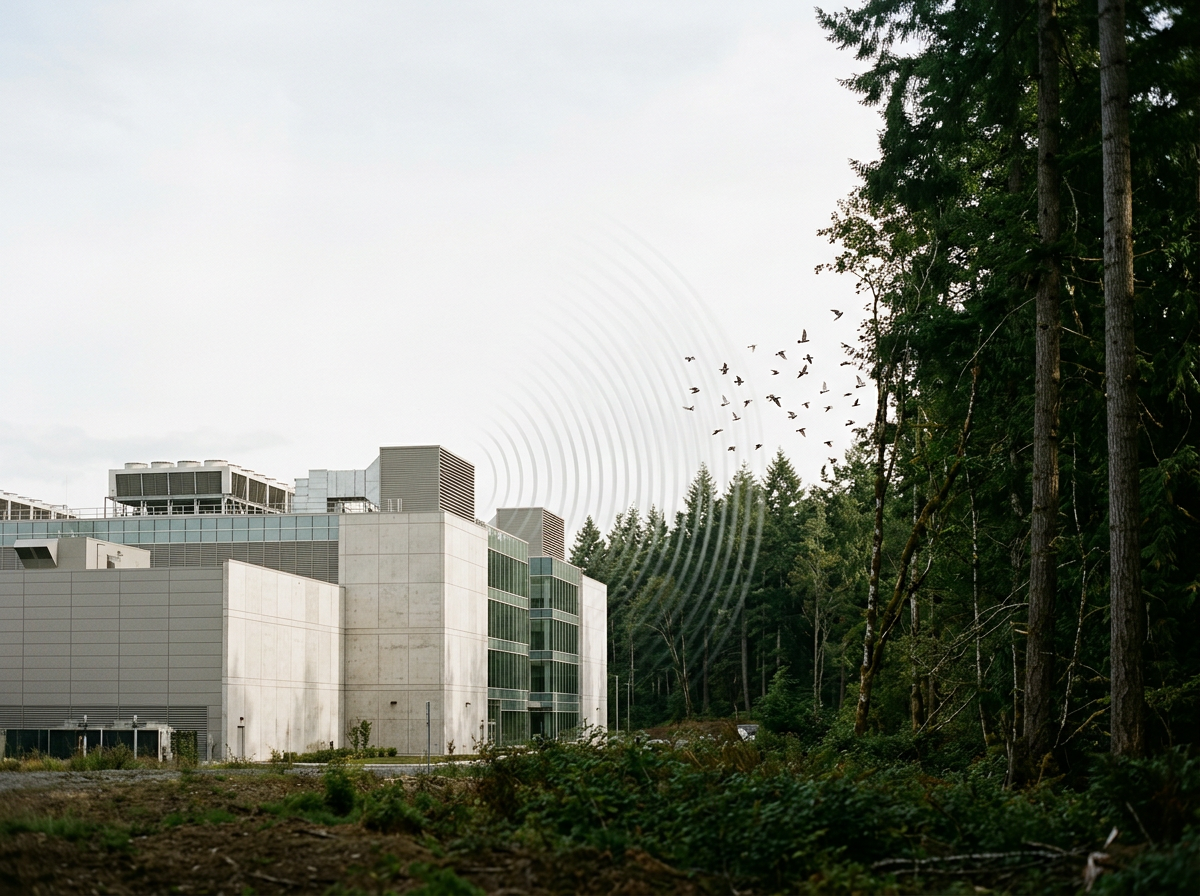
Drive past almost any new data center and you'll notice it before you see it: a low, continuous drone from banks of cooling fans, chillers, and backup generators that can run 24 hours a day, 365 days a year. Hyperscale data centers spread into rural and semi-rural landscapes, often sited near cheap land and available power rather than existing industrial corridors. That hum is becoming a fixture next to forests, wetlands, and farmland that were previously quiet. It turns out ecologists have already spent close to two decades studying almost exactly this kind of noise: continuous, low-frequency, industrial sound bleeding into wildlife habitat. Because low-frequency sound has long wavelengths, this hum can travel a long way into the forest. Their subject wasn't data centers, it was natural-gas compressor stations and traffic corridors, but acoustically the two are close cousins. Below is a look at what that research says about how chronic mechanical noise affects birds, organized around three distinct outcomes: nesting, hunting, and stress.
Nesting Interference
The foundational study here comes from a natural experiment in New Mexico's pinyon-juniper woodlands, where researchers took advantage of noisy gas-well compressors sitting next to otherwise-identical quiet well pads to isolate noise as a single variable. In Noise Pollution Changes Avian Communities and Species Interactions (Francis, Ortega & Cruz, Current Biology, 2009), the noisy sites hosted measurably fewer nesting species than the quiet ones: 21 versus 32 species over three breeding seasons, even though overall nest density didn't change. Birds weren't avoiding the habitat wholesale; entire species were being filtered out, replaced by a narrower set of noise-tolerant nesters. A follow-up analysis, Noise Pollution Filters Bird Communities Based on Vocal Frequency (Francis, Ortega & Cruz, PLoS ONE, 2011), figured out why: it wasn't body size, urban tolerance, or song length that predicted which species nested in the noise, it was vocal pitch. Species that sing below about 2 kHz, which overlaps with where compressor (and generator, and transformer) noise concentrates its energy, had consistently negative nesting responses; species with higher-pitched calls were unaffected or even favored the noisy sites. Nesting effects aren't limited to small songbirds, either. In The Effects of Human Disturbance on Trumpeter Swan Breeding Behavior (Henson & Grant, Wildlife Society Bulletin, 1991), researchers documented nest abandonment and cygnet loss in large, low-frequency-voiced waterfowl exposed to chronic human activity near breeding sites. This work is a reminder that the species most likely to be masked out of a soundscape tend to be the larger-bodied, lower-pitched ones, which is not good news for a data center sited near a lake or wetland.
Hunting Interference
Nesting studies focus on communication, because birds need to hear each other for successful family formation. A separate and, for predators, arguably more direct pathway is birds needing to hear their prey. Owls are the best-studied case, because so many species locate rodents almost entirely by sound. In Traffic Noise Reduces Foraging Efficiency in Wild Owls (Senzaki et al., Scientific Reports, 2016), researchers playing back traffic noise near wild short-eared and long-eared owls found hunting success dropped by up to about 90% (depending on the noise level), with measurable effects extending more than 120 meters from the noise source. A 2025 study, Sensory Interference Shapes Habitat Suitability for an Acoustically Specialized Predator (Habib et al., Scientific Reports), used passive acoustic monitoring across hundreds of sites to show that northern saw-whet owls avoid landscapes with elevated noise specifically in the 1.6–7.1 kHz band (the exact frequency range where owl hearing is most sensitive to rustling and squeaking prey) and coined the term "acoustic displacement" for habitat loss that has nothing to do with vegetation or land cover, only with what a predator can hear. And in Experimental Noise and Light Pollution Alter Prey Detection in a Nocturnal Bird of Prey (Passarotto, Morosinotto & Karell, Journal of Animal Ecology, 2025), tawny owls exposed to both noise and artificial light showed impaired prey detection specifically through the acoustic channel, not the visual one. This last detail is important given that data centers are notorious for combining round-the-clock mechanical noise with round-the-clock security lighting.
Stress and Distraction
Not every effect of noise shows up as a bird leaving, or missing a meal. Some of the cost is purely physiological, or behavioral in ways that are easy to miss without measuring hormones directly. A large portion of human worries about noise are related to stress response, as constant noise exposure leads to higher cortisol levels, which can lead to cardiovascular and endocrine problems later on. This is true in humans, but is it also true for wildlife?
In Population, Behavioural and Physiological Responses of an Urban Population of Black Swans to an Intense Annual Noise Event (Payne et al., PLoS ONE, 2012), swans exposed to a loud annual event showed no obvious behavioral abandonment of the site, but their stress-hormone (corticosterone) levels rose measurably, evidence of a physiological cost that a simple headcount or vegetation survey would never catch. Noise doesn't even have to be constant to matter: in Experimental Evidence for the Effects of Chronic Anthropogenic Noise on Abundance of Greater Sage-Grouse at Leks(Blickley, Blackwood & Patricelli, Conservation Biology, 2012), researchers directly compared continuous drilling noise to intermittent road noise at the same average volume and found the intermittent noise caused the larger drop in lek attendance (73% versus 29%) because animals seem to process unpredictable noise as a potential threat rather than simply tuning it out. That distinction is laid out explicitly in A Framework for Understanding Noise Impacts on Wildlife: An Urgent Conservation Priority (Francis & Barber, Frontiers in Ecology and the Environment, 2013), which draws a line between noise that interferes with hearing important sounds (masking) and noise that is itself perceived as a signal of danger (distraction or threat). These are two separate mechanisms with separate fixes, and both plausibly in play wherever generators cycle on and off unpredictably rather than humming along at a constant level.
[TL;DR]
Put together, this body of research says three things fairly clearly: chronic industrial noise changes which bird species can successfully nest in a given landscape, and it does so in a predictable way tied to a species' vocal pitch, not just its general noise tolerance; it directly reduces the hunting success of acoustic predators like owls, sometimes by a striking margin, over distances well beyond what most siting reviews would consider a buffer; and it imposes physiological and behavioral costs, such as stress, vigilance, avoidance, that persist even in species that appear, superficially, to be tolerating the disturbance just fine.
We should be clear that none of the studies above were conducted at an actual data center, however: a facility's specific noise signature (mostly continuous fan and chiller noise, punctuated by intermittent, higher-amplitude generator testing) will interact with local bird communities in ways that depend on the exact frequencies and bird species involved. But the acoustic profile of a large data center campus (constant low-frequency mechanical noise, running around the clock, often paired with security lighting, and often sited on undeveloped land at the edge of existing habitat) maps onto the noise sources these researchers already studied more closely than almost any other class of development. As data center construction accelerates into new landscapes, the question isn't really whether this literature applies. It's whether anyone doing the siting is reading it.
In Space, No One Can Hear You Compute
Since Congresswoman Alexandria Ocasio-Cortez asked her congressional committee if anyone would want to live next to a data center, many have observed that an anti-data center movement is one of the few bipartisan issues in highly polarized America today. AOC has mentioned both water use and noise as two of the most undesirable aspects of data centers. However, it’s useful to realize that these two issues are also at odds with each other: most data center noise comes from air-cooling systems, which generates low-frequency sound energy. Water-cooled systems are often more expensive to build, but by using water instead of air, they can also be built vastly quieter if a large source of water is available. Many data center companies prefer to instead build a cheaper air-based system and simply pay for a poorly-written sound study which gives projected values in dBA but does not actually have any predictive power for noise annoyance in the surrounding area.
Now a lot of the Silicon Valley conversation has shifted to Elon Musk’s assertion that SpaceX will be able to shift data centers into outer space. From a solar power perspective and zoning perspective, this makes a certain amount of sense, as well as some hopeful assertions about the efficiency of radiative cooling in orbit. However, from a noise perspective the advantage would obviously be that all sound stops in the vacuum of space, and we back down on the surface will not have to hear these hundreds of thousands of servers spinning all day.
I don’t claim to be a spaceflight engineer, but Sam Harsimony at Splitting Infinity recently posted reasons for thinking that given the presence of convective as well as radiative cooling on Earth makes cooling more efficient on Earth than in space under most radiator temperatures:
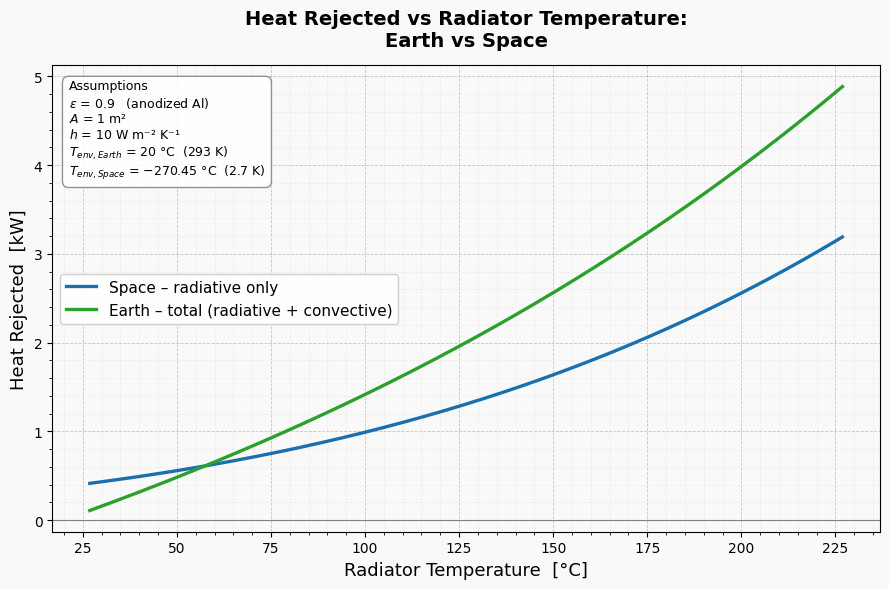
(see here for a more optimistic take on the economics of data centers - you can add your own assumptions and put it into a calculator…). Clearly space would need to have a big built-in price advantage at some level to make the physics of this seem even remotely plausible for VC investors.
Aside from purely economic considerations, IEEE has a great Youtube video showing many other engineering considerations required for space-based data centers that haven’t been fully addressed by the space-stans yet. (Did you know that the ISS requires 3 separate servers running redundantly from each other to protect against bit-flipping from cosmic rays?) As the video concludes, military use might be the main instigator of space-based data centers because a) they don’t need to make a profit, and b) they would be hard for most people to destroy once they’re up there.
However, the military application is not the primary type of data center most people are worried about when they ask me about data center noise (clearly the US Army has been exploding things since before noise codes existed). For commercial data centers, the economics are key, and based on current technology and fuel prices, the economics don’t make space-based data centers look like they’re likely to be a realistic noise abatement strategy in the next 5-10 years.
It’s worth emphasizing, too, that if we could write a reasonable data center noise ordinance which actually dealt with low-frequency noise and adequately priced the externalities these data centers create, that regulation itself could help shift the needle toward making space-based data centers more cost-effective. Clearly the demand for compute is not going away - it is merely a question of where we are going to put it.
The Other Type of Data Center Noise
I just posted about the failure of a “Data Center Noise Ordinance” because it didn’t adequately account for low frequency sound. Low frequency noise is by far the most common type of noise complaint from data centers: they have long wavelengths, travel long distances, and can bend around obstacles.
However, of course as soon as I posted that I also came across this Politico story about a high-pitched whine from a data center next door. So should we be equally concerned about high-frequency noise?
In general, no: this particular data center seems to have been running its backup diesel generators, which caused the high-frequency you can hear in the video linked in the story. This is likely because those diesel generators use a turbocharger compressor, which generates a resonant frequency at the Blade Pass Frequency. You can see in the animation below how this leads to a high-frequency pressure oscillation:
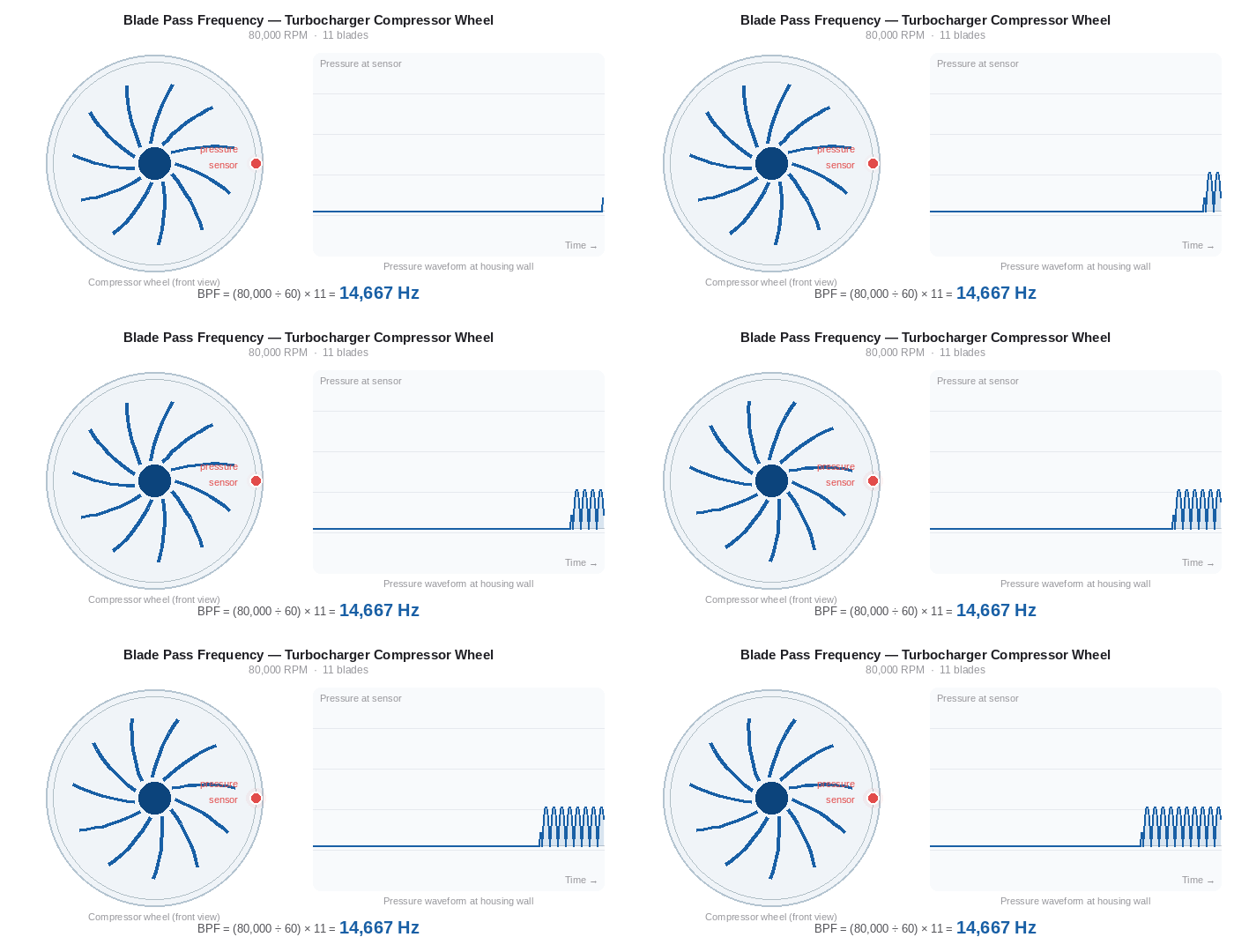
Animation Showing Blade Pass Frequency in a Diesel Turbocharger
High-frequency noise is essentially the opposite of low-frequency noise: where low-frequency noise is diffuse and subtle, high-frequency noise is intense and local. It doesn’t travel so far, and is more easily blocked by obstacles or absorbed by the air. Thus the noise mitigation solutions will be different for this case. Unlike most data center noise issues, this is also an area where the A-weighted dB rating will be useful for quantifying annoyance.
However, backup generators usually only run during emergencies or brief testing periods, so they’re not likely to be the main noise complaint for most data centers. But since Loudoun County has 200 data centers at the moment, we are bound to have some high-frequency issues here and there.
How Not to Write a Data Center Noise Ordinance
One of the big problems with data center noise is that it often affects rural areas, where neighbors have an expectation of peace and quiet. Data centers originally became an issue in suburban DC, but since the AI boom they are now expanding into places like Conway, Arkansas:
In 2023, Conway’s leadership adopted a Data Center Noise Ordinance, the most stringent noise regulation applied to any commercial or industrial use in Conway. The noise level allowed at the property cannot be above typical conversation volume.
The facility’s design includes noise mitigation and will be subsequently reviewed for noise concerns. Noise levels will be evaluated on an ongoing basis.
That sounds promising! But on inspection of the ordinance in question, it’s not so promising…
It shall be unlawful for any Data Center to make or continue to cause or permit to be made or continued, noise levels constituting a noise disturbance. For the purposes of this section, the external noise level emanating from Data Centers shall be deemed disturbing to a person, reasonably calculated to disturb the peace and unreasonably offensive and injurious to the public, or their property, if the sound level is … 65 dBa or higher during the hours of 8 A.M. to 10 P.M. or 55 dBa or higher during the hours of 10 P.M. to 8 A.M. (as determined by a third-party acoustic engineer) measured at the property line of the receiving property.
Now, there are some good things there (such as a stricter limit for nighttime conditions, when you’re trying to sleep and there’s less background noise). But when the daytime limit is written in such a way to completely miss data center noise in the first place, the stricter nighttime limit may not be strict enough either.
Below you can see two graphs: the first shows the A-weighted and C-weighted curves used to measured dBA and dBC. The second graph shows the difference between the curves, by frequency (in dB).
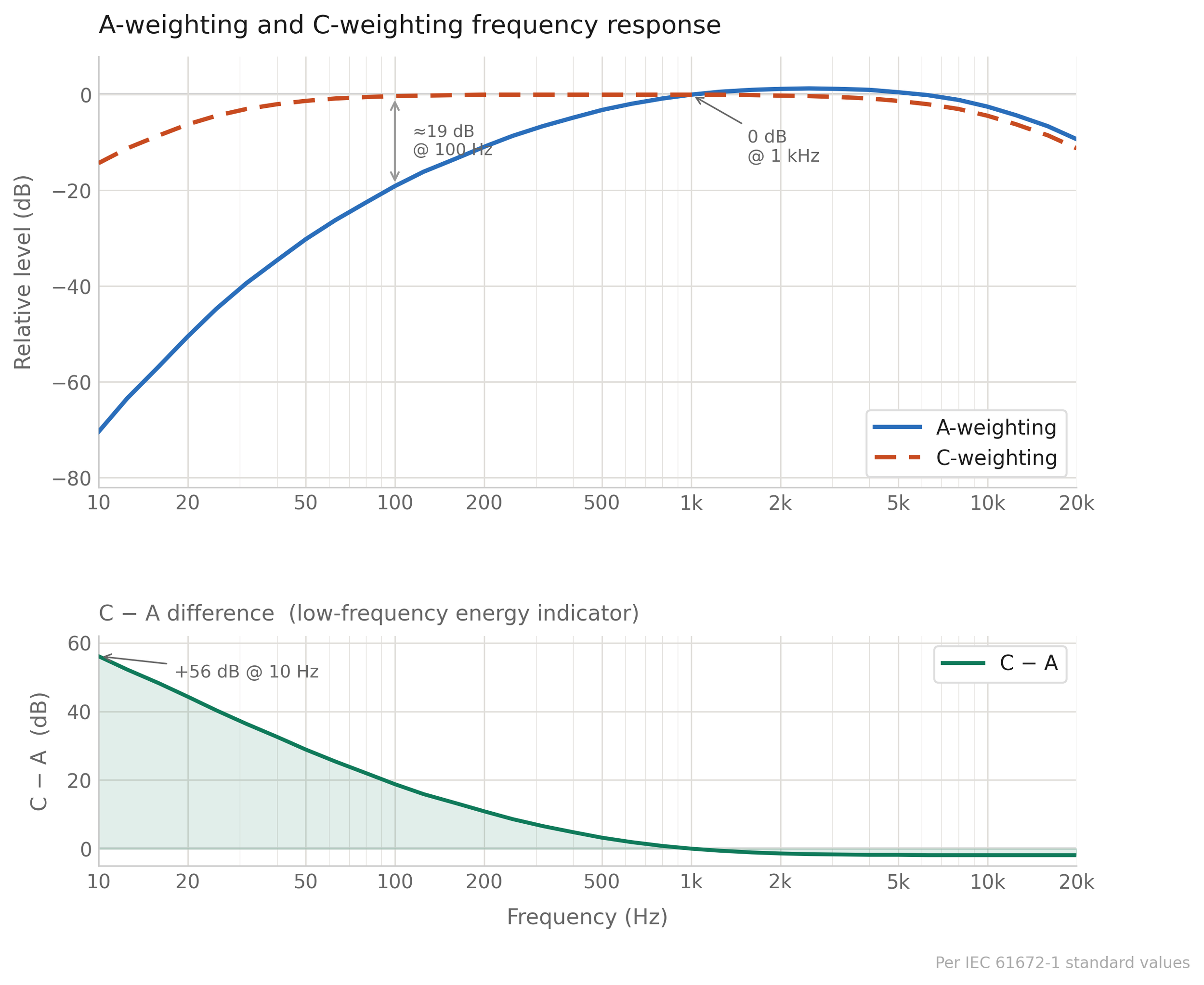
dBA vs. dBC, by frequency (Hz)
The A-weighted curve approximates the frequency response of the human ear at moderate levels (about 60 dB, like a conversation). The C-weighted curve approximates the frequency response of the human ear at higher levels (about 80 dB, like a busy city street). You can see that the ear becomes much more sensitive to low-frequency sound when the overall sound pressure level increases.
Data center noise is often around 100 Hz (sometimes lower, sometimes higher), which corresponds to a 19 dB difference between the C-weighted curve and the A-weighted curve. So when the Conway ordinance allows noise levels up to 65 dBA during the day, that would actually allow overall pressure of about 84 dB if all the energy is concentrated in a low-frequency hum at 100 Hz, as is typical of data centers.
A-weighted values are the most obvious way for data centers to hide the true extent of the their noise! Any noise ordinance which purports to deal with data centers should require C-weighted values at the very least.
We are going to need better data center noise ordinances, but this is not the way to write one.
Data Centers: Noise in the 21st Century
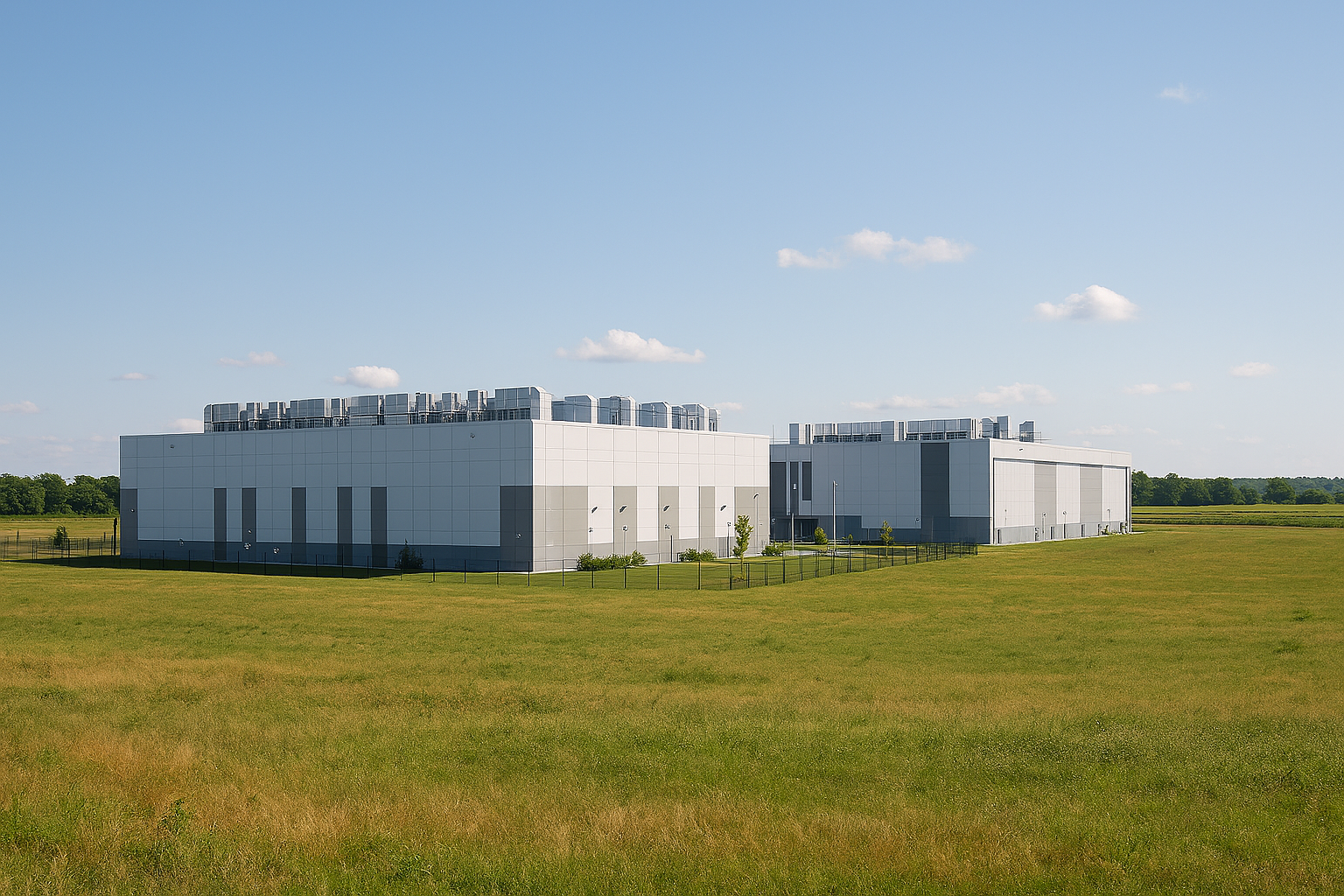
Data Centers Emit Low-Frequency Noise, Which Can Be Annoying in Quiet Rural Areas
Noise is not a modern problem. It may surprise you that there are numerous accounts of noise complaints in the early days of colonial America, but they were different from the types of noise we associate with cities today: while our cities are packed with cars and constant humming of HVAC systems, Philadelphia in the 18th century was full of horseshoes clomping on cobblestone streets and batting rods beating the laundry dry. 18th century noise was short and impulsive; 21st century noise is long and constant.
And there is perhaps no more iconic noisy symbol of the internet age than the data center. These large campuses full of buildings, full of servers, generate immense heat and require huge cooling either through water or air. Air-cooled data centers (which are the most common) generate high amounts of noise from the hot air blowing out the tops of these buildings. While the fans themselves produce disproportionately low-frequency noise, the noise itself becomes more lowpass filtered due to diffraction effects (the ability of sound waves to bend around edges) over the top of the building and via atmospheric air absorption, which only affects higher frequencies and lets the low frequencies pass through.
Our ears are somewhat less sensitive to low-frequency noise, but only up to a point: as the pressure at low frequencies increases, our ears become more sensitive to it, leading the noise to be perceived as a rattling or humming, depending on the exact frequencies present. As the AI age progresses, the data center buildout is leading to numerous cases of neighbors who are only now realizing what it means to live next to a constant low frequency hum. Since the lowest frequencies have the largest wavelengths, even building a costly wall is not enough in some cases to stop the hum.
It is not beyond our technical means to make quiet data centers, but it will cost more. The regulatory framework hasn't kept pace, and most municipal noise codes fall into one of two camps:
Some do not specify a numerical dB noise limit at all
Others specify a limit only in A-weighted decibels (or dBA)
A value in dBA is useful if you’re looking at speech, or music, or many of the sounds our ears are most sensitive to. But dBA systematically underweights low-frequency energy because it assumes the overall pressure is low enough that our ears will not be sensitive to it. However, when the pressure builds up, reporting only dBA values can hide the true problem because the total sound energy can be much louder than the dBA value.
How Should We Measure Data Center Noise?
This is why for data center projects I recommend reporting C-weighted decibels (or dBC) values. If there’s not much low-frequency energy, the dBA value is a good estimate for the sound’s loudness, but dBC is used in cases where there’s significant low-frequency energy (like for booming subwoofers from NYC nightclubs, for instance). An exact dBC limit may vary somewhat by municipality: in very quiet rural areas, there is not a lot of other noise and our auditory system may be conscious of the low-frequency hum, leading to greater community annoyance. In noisier urban/suburban environments, which may have greater noise in the higher-frequency region of our hearing range, the low frequencies will often not be noticed if there is sufficient masking energy above them. However, if the low-frequency noise is great enough, it can still lead to negative health effects even when it is not heard! These health effects are part of why community opposition to data centers has grown, though not all of it is well-founded. There is a lot we still don’t know about low-frequency noise exposure.
Some data center opposition is pure NIMBYism (“Not In My Back Yard!”), a knee-jerk reaction against building anything new. I am not opposed to data centers! This very article is hosted online, stored in the cloud in a data center. You wouldn’t be reading it if not for data centers. The AI revolution has the potential to transform the modern economy for the better (or not, but that’s a separate problem).
I am in favor of building out more data centers, but we need to do so in a way that does not alienate the surrounding neighbors. Sufficient interior noise absorption, rooftop barriers, and fan retrofits to reduce resonant noise components are all available and can reduce the low-frequency hum to manageable levels. Well-designed mitigation options can reduce the noise by 10-15 dB, which is usually enough to reduce the noise below the threshold of community annoyance. It will be somewhat more expensive, but it will allow the data center buildout to be more sustainable and to exist in harmony with the land it is occupying.
Science for People
I went to graduate school with a great love for physics and a sense of wonder at how our auditory system works to help us understand the world around us. I chose to stay in academia because I wanted the freedom to work on research topics that interested me, without having to kowtow to management. Often this took me in directions which were decidedly non-commercial (understanding the acoustics of Bach’s church or trying to predict the effects of noise transmission during the pandemic). Sometimes these forays into other fields also led back to more basic questions in physics, as new questions necessitate new methods to answer them.
However, having received tenure at American University, I’ve realized that I don’t have to spend all my time on narrow academic questions, and in fact it is refreshing and uplifting to spend time applying what we know about acoustics, noise, and sound perception to real-world problems faced by ordinary people. Just as interdisciplinary work can lead back to new questions for science to answer, so can applied work cross-fertilize between the scientific rigor of the university with the quick-moving solutions of the free market. I will always be an academic first, but I hope here to use science to help people understand sound better and help their world sound better too.