The Hum in the Woods: What We Know About Data Center Noise and Birds
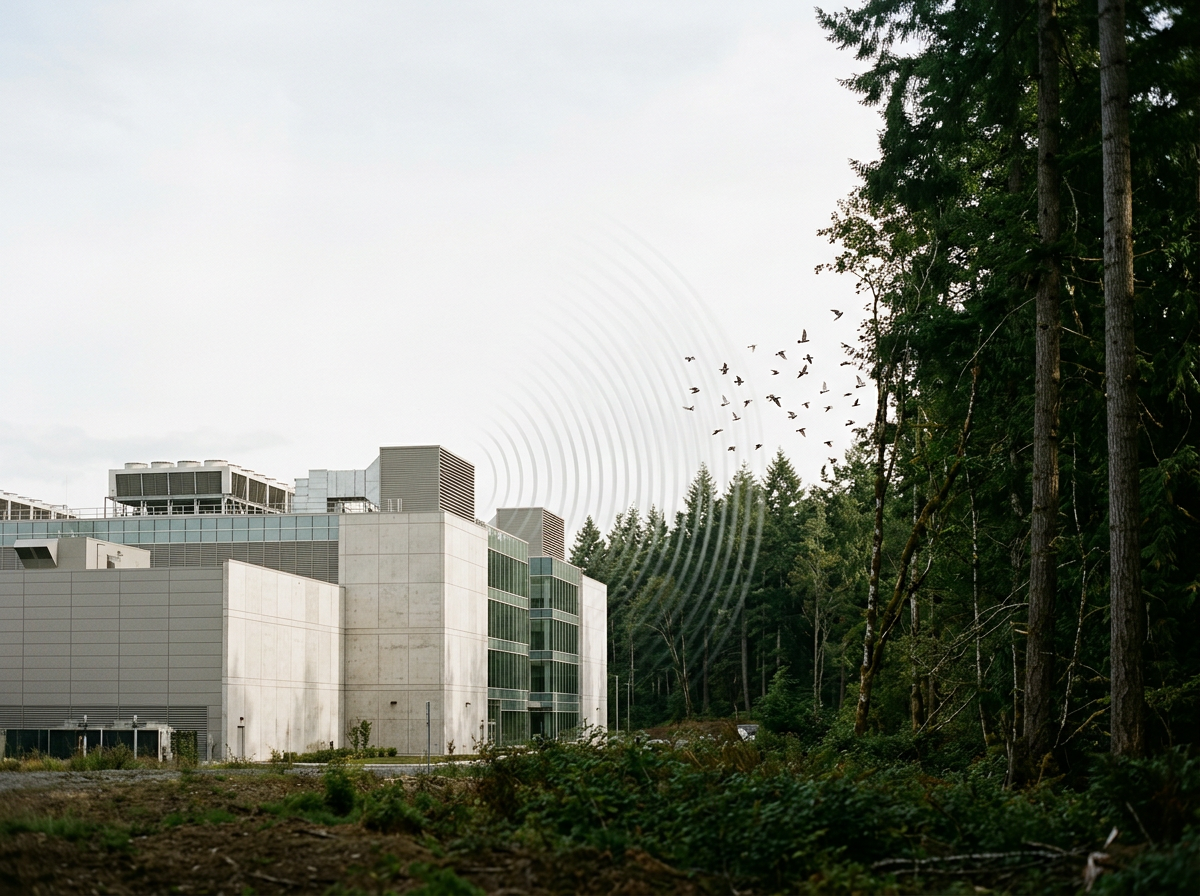
Data Center Vs. The Birds
Drive past almost any new data center and you'll notice it before you see it: a low, continuous drone from banks of cooling fans, chillers, and backup generators that can run 24 hours a day, 365 days a year. Hyperscale data centers spread into rural and semi-rural landscapes, often sited near cheap land and available power rather than existing industrial corridors. That hum is becoming a fixture next to forests, wetlands, and farmland that were previously quiet. It turns out ecologists have already spent close to two decades studying almost exactly this kind of noise: continuous, low-frequency, industrial sound bleeding into wildlife habitat. Because low-frequency sound has long wavelengths, this hum can travel a long way into the forest. Their subject wasn't data centers, it was natural-gas compressor stations and traffic corridors, but acoustically the two are close cousins. Below is a look at what that research says about how chronic mechanical noise affects birds, organized around three distinct outcomes: nesting, hunting, and stress.
Nesting Interference
The foundational study here comes from a natural experiment in New Mexico's pinyon-juniper woodlands, where researchers took advantage of noisy gas-well compressors sitting next to otherwise-identical quiet well pads to isolate noise as a single variable. In Noise Pollution Changes Avian Communities and Species Interactions (Francis, Ortega & Cruz, Current Biology, 2009), the noisy sites hosted measurably fewer nesting species than the quiet ones: 21 versus 32 species over three breeding seasons, even though overall nest density didn't change. Birds weren't avoiding the habitat wholesale; entire species were being filtered out, replaced by a narrower set of noise-tolerant nesters. A follow-up analysis, Noise Pollution Filters Bird Communities Based on Vocal Frequency (Francis, Ortega & Cruz, PLoS ONE, 2011), figured out why: it wasn't body size, urban tolerance, or song length that predicted which species nested in the noise, it was vocal pitch. Species that sing below about 2 kHz, which overlaps with where compressor (and generator, and transformer) noise concentrates its energy, had consistently negative nesting responses; species with higher-pitched calls were unaffected or even favored the noisy sites. Nesting effects aren't limited to small songbirds, either. In The Effects of Human Disturbance on Trumpeter Swan Breeding Behavior (Henson & Grant, Wildlife Society Bulletin, 1991), researchers documented nest abandonment and cygnet loss in large, low-frequency-voiced waterfowl exposed to chronic human activity near breeding sites. This work is a reminder that the species most likely to be masked out of a soundscape tend to be the larger-bodied, lower-pitched ones, which is not good news for a data center sited near a lake or wetland.
Hunting Interference
Nesting studies focus on communication, because birds need to hear each other for successful family formation. A separate and, for predators, arguably more direct pathway is birds needing to hear their prey. Owls are the best-studied case, because so many species locate rodents almost entirely by sound. In Traffic Noise Reduces Foraging Efficiency in Wild Owls (Senzaki et al., Scientific Reports, 2016), researchers playing back traffic noise near wild short-eared and long-eared owls found hunting success dropped by up to about 90% (depending on the noise level), with measurable effects extending more than 120 meters from the noise source. A 2025 study, Sensory Interference Shapes Habitat Suitability for an Acoustically Specialized Predator (Habib et al., Scientific Reports), used passive acoustic monitoring across hundreds of sites to show that northern saw-whet owls avoid landscapes with elevated noise specifically in the 1.6–7.1 kHz band (the exact frequency range where owl hearing is most sensitive to rustling and squeaking prey) and coined the term "acoustic displacement" for habitat loss that has nothing to do with vegetation or land cover, only with what a predator can hear. And in Experimental Noise and Light Pollution Alter Prey Detection in a Nocturnal Bird of Prey (Passarotto, Morosinotto & Karell, Journal of Animal Ecology, 2025), tawny owls exposed to both noise and artificial light showed impaired prey detection specifically through the acoustic channel, not the visual one. This last detail is important given that data centers are notorious for combining round-the-clock mechanical noise with round-the-clock security lighting.
Stress and Distraction
Not every effect of noise shows up as a bird leaving, or missing a meal. Some of the cost is purely physiological, or behavioral in ways that are easy to miss without measuring hormones directly. A large portion of human worries about noise are related to stress response, as constant noise exposure leads to higher cortisol levels, which can lead to cardiovascular and endocrine problems later on. This is true in humans, but is it also true for wildlife?
In Population, Behavioural and Physiological Responses of an Urban Population of Black Swans to an Intense Annual Noise Event (Payne et al., PLoS ONE, 2012), swans exposed to a loud annual event showed no obvious behavioral abandonment of the site, but their stress-hormone (corticosterone) levels rose measurably, evidence of a physiological cost that a simple headcount or vegetation survey would never catch. Noise doesn't even have to be constant to matter: in Experimental Evidence for the Effects of Chronic Anthropogenic Noise on Abundance of Greater Sage-Grouse at Leks(Blickley, Blackwood & Patricelli, Conservation Biology, 2012), researchers directly compared continuous drilling noise to intermittent road noise at the same average volume and found the intermittent noise caused the larger drop in lek attendance (73% versus 29%) because animals seem to process unpredictable noise as a potential threat rather than simply tuning it out. That distinction is laid out explicitly in A Framework for Understanding Noise Impacts on Wildlife: An Urgent Conservation Priority (Francis & Barber, Frontiers in Ecology and the Environment, 2013), which draws a line between noise that interferes with hearing important sounds (masking) and noise that is itself perceived as a signal of danger (distraction or threat). These are two separate mechanisms with separate fixes, and both plausibly in play wherever generators cycle on and off unpredictably rather than humming along at a constant level.
[TL;DR]
Put together, this body of research says three things fairly clearly: chronic industrial noise changes which bird species can successfully nest in a given landscape, and it does so in a predictable way tied to a species' vocal pitch, not just its general noise tolerance; it directly reduces the hunting success of acoustic predators like owls, sometimes by a striking margin, over distances well beyond what most siting reviews would consider a buffer; and it imposes physiological and behavioral costs, such as stress, vigilance, avoidance, that persist even in species that appear, superficially, to be tolerating the disturbance just fine.
We should be clear that none of the studies above were conducted at an actual data center, however: a facility's specific noise signature (mostly continuous fan and chiller noise, punctuated by intermittent, higher-amplitude generator testing) will interact with local bird communities in ways that depend on the exact frequencies and bird species involved. But the acoustic profile of a large data center campus (constant low-frequency mechanical noise, running around the clock, often paired with security lighting, and often sited on undeveloped land at the edge of existing habitat) maps onto the noise sources these researchers already studied more closely than almost any other class of development. As data center construction accelerates into new landscapes, the question isn't really whether this literature applies. It's whether anyone doing the siting is reading it.